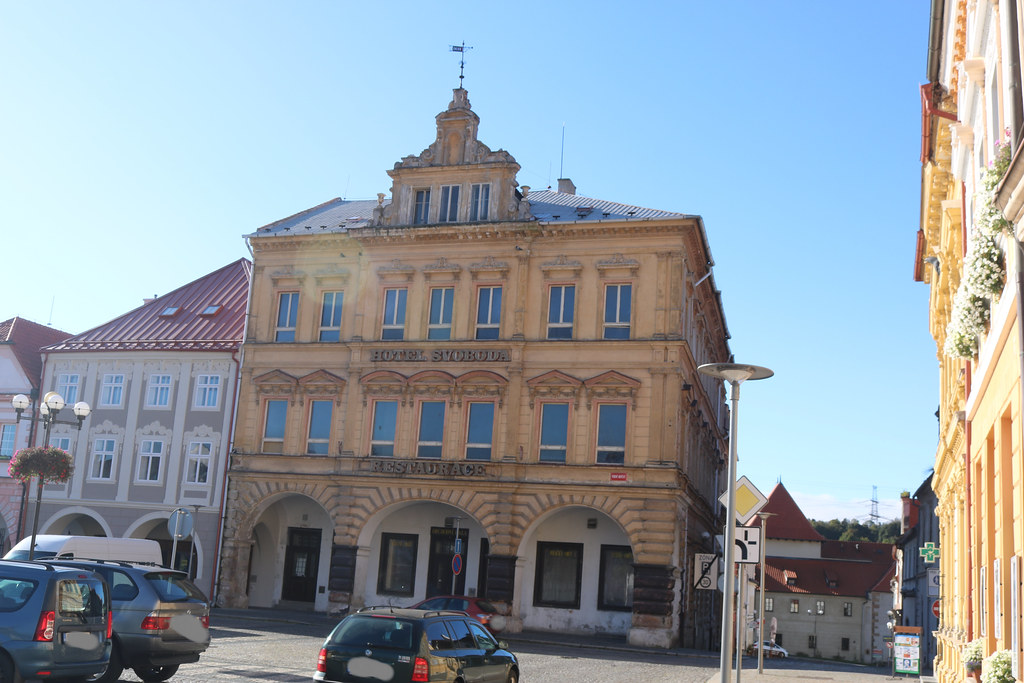
Visited:30. 9. 2021
History:The current house No. 122 can be described as a new building compared to other historical houses in the central square of Kadan. It was built in 1890, as can be seen from the metal weathervane on its gable. On the site of the demolished municipal brewery, it was built by the Jewish merchant Ludwig Löwy of Kadan in a richly decorated historic style and housed the Hotel Austria with a restaurant and a café, respecting the wishes of the city councillors and adding an arcade, which is typical of the other buildings on the square and also recalls the original brewery building, which was also equipped with one. It was in the Hotel Austria that the first festive assembly of the renewed Jewish community in Kadan was held in 1893 and the hotel soon became the centre of Kadan's cultural, political and social life. From 1908 Josef Gangl was the owner of the hotel and since after the establishment of Czechoslovakia in 1918 the existing name was politically untenable, the hotel was renamed and thus acquired the name of its new owner. Hotel Gangl had forty-two rooms, the restaurant was famous for its specialties and at one time a French chef worked there. There was also a bus stop right in front of the building, from where hotel guests could quickly and comfortably get to the main railway station Kadaň-Prunerov. During the First World War (1914-1918), the hotel with its restaurant and café facilities was particularly popular among the soldiers of the local garrison and was probably also visited by the artist Josef Čapek, the writer Jaroslav Havlíček, the photographer Josef Sudek, the journalist Arne Laurin or the actor Vojta Matys, who served in Kadan at that time. House No. 122 also played an unfortunate role on 4 March 1919, when one of the machine guns used to fire during the so-called Kadan Massacre was placed there, during which Czechoslovak soldiers in a heated situation began firing into the pavement of the square during a demonstration of Kadan Germans, and the reflected projectiles caused the tragic result of this incident, which was almost thirty dead and about eighty wounded. In 1945, the house was confiscated from the Gangl family as so-called German property under the so-called Benes Decrees and subsequently renamed the Svoboda Hotel. In 1947, a concert stage was even set up in front of the hotel, because it had become a centre of Kadani's renewed tourism. From 1948 onwards, negotiations took place to establish a Youth Hostel in the premises of the Svoboda Hotel. Between 1950 and 1951, the Army House for social events of the local military garrison briefly functioned here, and then a dormitory for students of the Industrial School of Construction was actually established. In the 1960s, the interior of the hotel restaurant was renovated, which also housed a remarkable mosaic by the artist Růžena Tikvová-Ríčanová. The Svoboda Hotel came to life in the "golden sixties" with youth entertainments and events for the fans of free culture. Between 1989 and 1992, the hotel was frequently visited by the evangelical pastor Petr Pazdera Payne, a signatory of Charter 77 and later a Czech writer. The hotel ceased to serve its purpose in the mid-1990s. The surroundings of the former hotel are also the backdrop of the autobiographical novels Wolf Skin (1939/1967) by Jaroslav Havlíček and Erlkönigs Reich (1997) by the German-Jewish writer Peter Finkelgruen, reflecting the tragic and contradictory fate of the town of Kadan, Bohemia and Europe in the 20th century.
Source:https://cs.wikipedia.org/wiki/D%C5%AFm_Austria_(Kada%C5%88)
Impressions:A beautiful townhouse, which is one of the dominant features of the local square.