Visited:21. 6. 2021
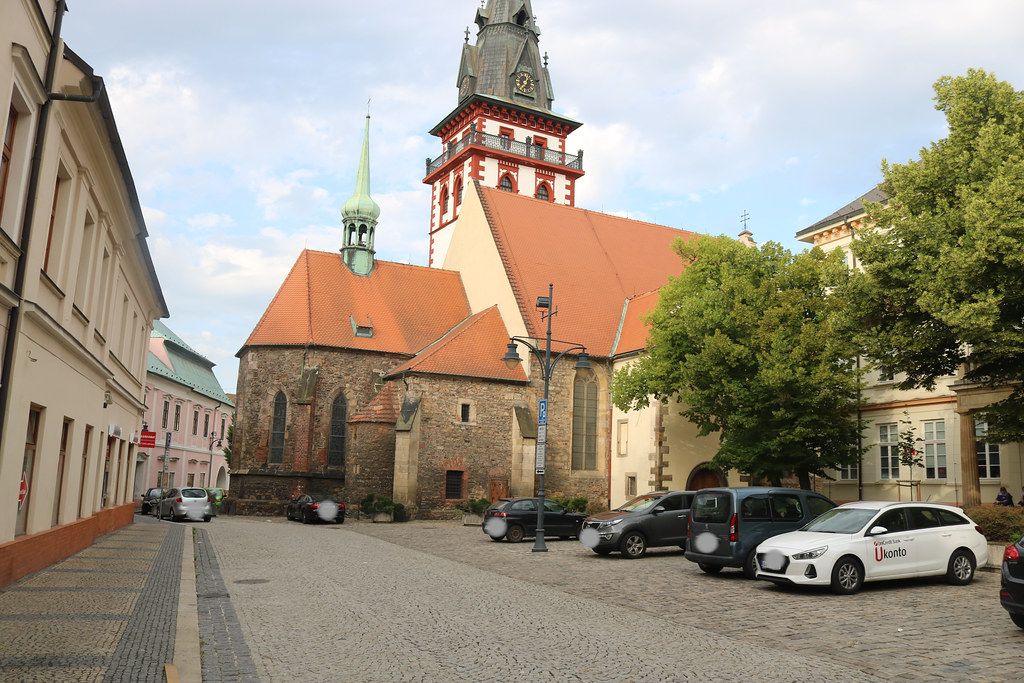
History:The Church of the Assumption of the Virgin Mary is a Gothic building standing in the centre of the town of Chomutov, which since its foundation has benefited from its location as an important town on the trade route from Bohemia to Saxony. The first mention of the church dates back to 1330, when a document confirming the rite issued by John XXII to Conrado Hrdony, rector of the parish church in Chomutov ("Conrado Hrdony, rectori parochialis ecclesiae in Chomutov") was dated. The oldest part of the church, the chancel and sacristy, also dates from this period. Until 1488, the right of submission belonged to the Order of German Knights, then to the Veitmils and later to the Lobkowiczs. In 1516, the Lords of Veitmile initiated the Renaissance reconstruction of the church under the direction of the master stonemason Josef Schreml (known from the Annaberg stonemasons' congress in 1518) and laid the foundations for the present appearance of the building. Until 1531, the church was surrounded by a cemetery (the suburb of Hřbitovní was created by the newly relocated cemetery). The main triple nave was vaulted in 1539 by Master Jacob Hans, and in 1542 the west music gallery was built. The south tribune was not completed until 1585 (the coat of arms of Bohuslav Jáchym Hasištejnský of Lobkowice and Anna of Redern on the bay window of the tribune). The presbytery and chapel on the south side date from the last quarter of the 16th century. The presbytery was re-glazed after 1625 and repairs were made to the roof trusses and roofing at the same time. In 1632 the church was sacked by the Saxons, in 1639 and 1643 it was damaged by the Swedes. Subsequent repairs were carried out between 1641 and 1649. In 1699 the western main Renaissance gable was taken down. The church was completely repaired in 1723 and between 1873 and 1874, at which time the tower was re-clad, the present tower roof was built and new stained glass windows were installed in the presbytery. The cemetery around the church was finally closed in 1810. In 1899, the church was officially closed due to the state of disrepair of the walls and vaults (rupture) - the church was in danger of collapse. In 1905-1915, extensive Puritan reconstruction of the building took place according to the plans of arch. Gerstl, during which the pseudo-Renaissance western gable was bricked up, a new truss roof over the triple nave was erected and new brick and block buttresses were added. The consecration and reopening ceremony took place on 15 August 1915. As for the interior, the main altar is Baroque, made in 1723 by J. K. Vetter. It is decorated with columnar architecture with four corinthian canellated columns, between which are statues of St Peter and St Paul. In the centre of the nave is a late Gothic statue of the Madonna, made around 1500. In the superstructure is a sculpture of the Holy Trinity. The side altars are from the same period, the altar of St. Anne (columned with a modern image of St. Anne and statues of two saints) and the altar of the Virgin Mary (columned with statues of St. Wenceslas and St. John of Nepomuk and an image of the Virgin Mary). In the Baptismal Chapel there is the altar of the Childhood of Jesus from 1700 with a richly carved acanthus frame. The altar of St. Anthony of Padua in the chapel of the same consecration is also Baroque (1760). The pulpit is from the 17th century, modified in 1728 and stained by J. J. Fahrenschon.
Source:https://cs.wikipedia.org/wiki/Kostel_Nanebevzet%C3%AD_Panny_Marie_(Chomutov)
Impressions:A beautiful Gothic-Renaissance church, which is one of the landmarks of the town.