Visited:8. 5. 2020
History:Černý Potok (German: Pleil) is a village located about 4 kilometres southwest of Kryštofovy Hamry. The earliest settlement in the vicinity of Černý Potok, which was related to the processing of iron ore, is documented in the middle of the fourteenth century, when an iron mill called Pleil operated here near the state border in 1352. It was destroyed by the Hussites in 1429, but was later rebuilt and in 1533 belonged to the Annaberian burgher Vitus Wertwein, who built a steeple near the hammer. In the sixteenth century, the Tollmetscher on the Black Water, the Sponmühler on the White Stream and the ironworks founded by Bohuslav Felix Hasištejnský of Lobkowice were operating here. In 1604, the owner of Pleil was Samson Schindler of Hohenwald, who was allowed by Emperor Rudolf II to build a hammer mill and blast furnace. Six years later, the hammer master Christopher Rubner bought Schindler's share for 4,000 Meissen groschen kopecks. The enterprise, which stood on the territory of Sorgenthal, consisted of a blast furnace, a hammer, a mill and a brewery. He had the right to brew and tap beer for the miners and metallurgists and to slaughter cattle. The estate also included the iron ore mines on Kreuziger. Half of the whole enterprise was bought by Christian Misslich of Wilmstein, a Prague burgher. However, Christopher Rubner failed to pay the purchase price and the farm was taken back by the widow Dorota Schindler. At the beginning of the Thirty Years' War there were court disputes over the property and the owners changed, until in 1627 everything belonged to Kryštof Rubner again. During the subsequent events of the Thirty Years' War, Sorgenthal was destroyed. On the nearby moor, imperial troops clashed with the army of General Baner, who was defeated. Towards the end of the war, however, Sorgenthal was rebuilt and fell to Andreas Rubner, son of Christopher Rubner. At that time the farm consisted of two blast furnaces, three forges, a brewery, a mill, a sawmill and residential buildings. In 1654-1667 Otto Ihl of Blofeldt was the governor of Přísečnik, under whom an ash yard and a new sheet metal mill stood in Černý Potok. The first written mention of the settlement of Pleil dates back to 1787 and can be found in the Topographie des Königreiches Böhmen by Jaroslav Schaller. According to him, there were 23 houses in the village. Nineteen houses with descriptive numbers stood in Sorgenthal at the same time. Both villages belonged to the Přísečnik estate. Trade routes from Kadan to Saxony led through the village. In the Seven Years' War around 1758, fighting took place in the Black Stream valley between Prussian hussars and Croatian infantry. On the road to Přísečnici, the torsos of two mass graves have been preserved, one dating from the Seven Years' War and the other even older. During the eighteenth century a new corn mill, two sawmills, nitric acid and vitriol production and iron ore mining developed in Pleil. In 1780, a paper mill was established in Sorgenthal, which operated until 1861, when it burnt down and the then owner moved production to Chomutov. The village's location at a high altitude made effective agriculture impossible, and most of the inhabitants worked in the mines or in industry. They often commuted to Vejprt or Jöhstadt. In the nineteenth century, industrial production of thread, lace and tinsel developed, but small textile goods were also produced at home. In 1861 Gelink's paper mill burned down and the owner then moved production to Chomutov, where he founded the later Dehtochema. An important employer was the Flader factory, where firefighting equipment was produced and which employed 150 workers in 1895. Its limited production programme ended in the 1960s. Later, the Belet company had a tool shop in the factory building, and after that the building was used as an auto repair and turning shop. The office building was converted into the Port Arthur restaurant at the end of the twentieth century. Until 1945 there was a two-class school in Černý Potok. After the abolition of the patrimonial administration in the middle of the 19th century, the village became an independent municipality and lost its independence in 1961, where it became part of the municipality of Vejprty and in 1974 part of the municipality of Kryštofovy Hamry, where it belongs to the present day. In 1930 there were still 826 inhabitants, but after the end of World War II the German population was almost depopulated and in 1950 there were only 198 inhabitants and this number was decreasing. The present village of Černý potok was formed by the merger of Sorgenthal and Pleil in 1949. According to the 2011 census there were 28 inhabitants.
As far as local mining is concerned, ore veins were found in the Kremsiger Gebirge between Černý Potok and Přísečnic around 1340. According to earlier references and a report from 1716, silver-bearing galena veins and quartz veins were recorded here. However, by that time they had already been completely mined out, as even an earlier attempt to resume mining by Šebestián of Hasištejn in 1583 did not find any ore. Veins of similar composition were mined directly in Černý Potok in the Prince Bedřich mine. Here, however, magnetite was the main raw material extracted. The main mining operation at Kremsiger was the 700-metre-long Ferdinand adit, which was situated at the mouth of the stream below where the road to Vejprt crosses it. It drained a large number of shafts (but not all), which ranged in depth from four to forty metres. Most of the mines produced between 300 and 1000 tonnes of iron ore per year. A record of the clearing of a hereditary adit survives from 1665, and between 1709 and 1715 some 3,650 tonnes of ore were produced from twenty mines. The decline of the local mines began in the mid-nineteenth century and by 1890 no mines were working. The second iron ore site at Černý potok was Auspanner, which consisted of skarn lenses. The ore here was of lower quality because it contained more pyrite and chalcopyrite. The Auspanner mines were drained by the 400-metre-long Jan adit, which ran near the Ferdinand adit on the other side of the stream. There were several mines on it: Jan, Red Shaft, Vojtěch and Sting. The largest mine was the Anna with an annual output of 70 to 200 tonnes between 1825 and 1840. The Auspanner mines shared the same fate as the Kremsiger mines. To the east and west of the village (on the so-called Kreuziger) there were two skarn bodies with lenses of magnetite. On the eastern side, a number of mines were in operation, the largest of which was the Angel Castle (the annual average output was up to 500 tonnes of ore), where silver ore was also mined in the mid-nineteenth century. The western deposit, characterised by a greater conversion of magnetite to quartz, was mined by the Svornost, Faith in God and White Deer mines. Although most of the ore was shipped to Saxony, Smithy or Kalku, some of it was processed in local hammers. Between 1559 and 1564 and 1576, permission was granted to private entrepreneurs to process iron slag from the heaps of the former ironworks. Other hammers were located between Černý Potok and Kovářská. Their waste slag was used in the construction of the road connecting the two villages. The last attempts to mine iron ore near the road to Kovářská were made by Gustav Göttle from Ústí nad Labem in 1904-1913, but they were not successful due to lack of money. Modern exploration of mineral deposits in the vicinity of Černý Potok took place in 1955-1958. Only small deposits of magnetite were found without the possibility of economic exploitation.
Source:https://cs.wikipedia.org/wiki/%C4%8Cern%C3%BD_Potok
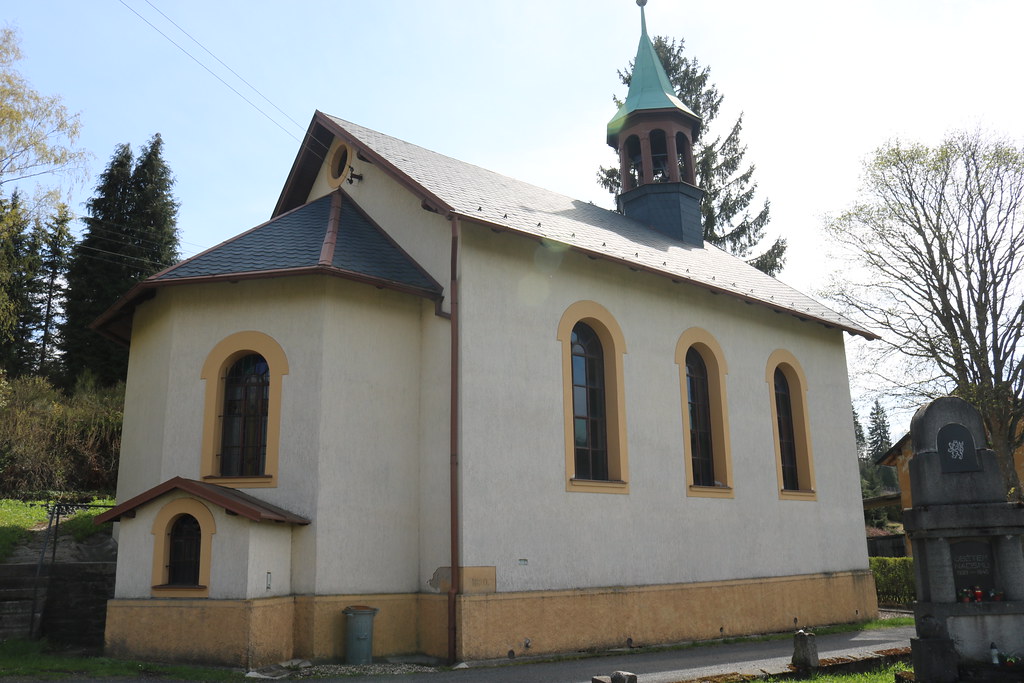
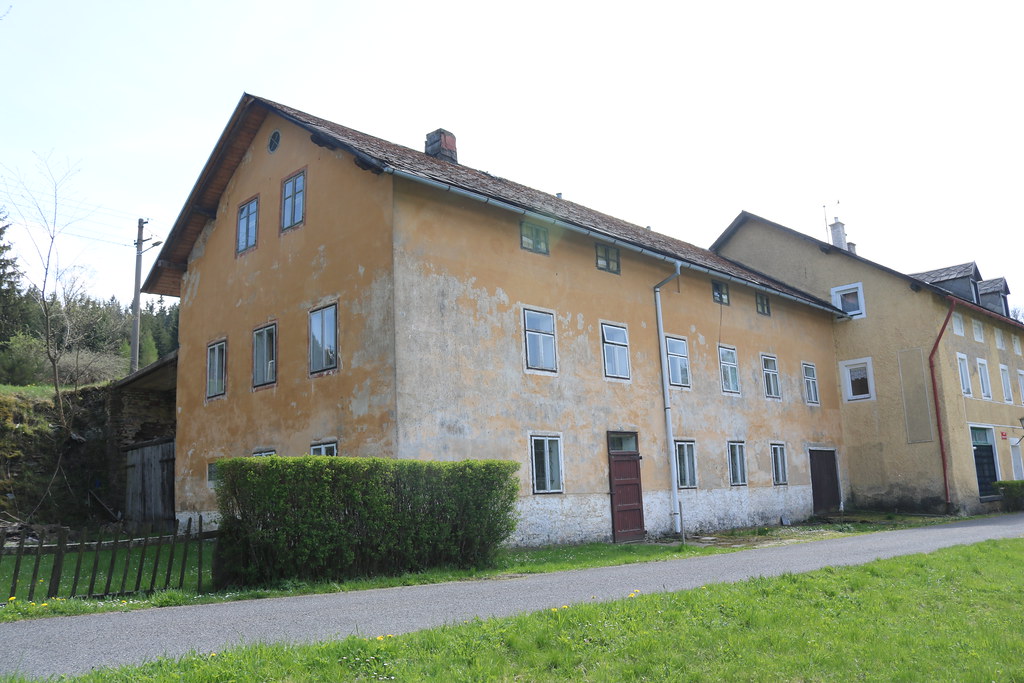
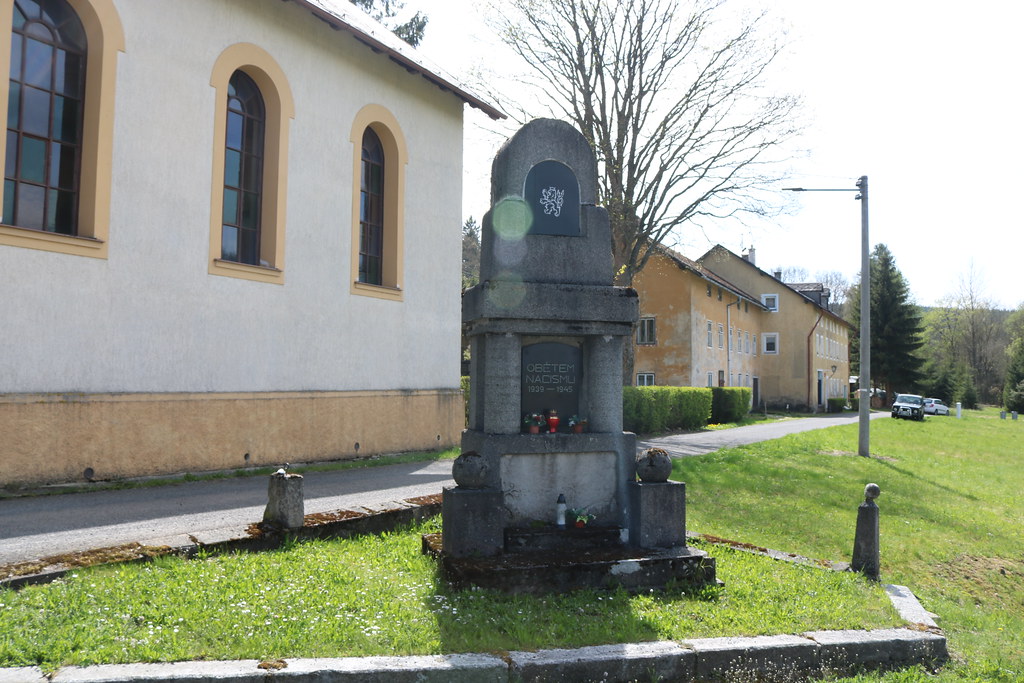
Impressions:Today it is a tiny village, located southeast of Kryštofovy Hamry, where there are a few interesting things.