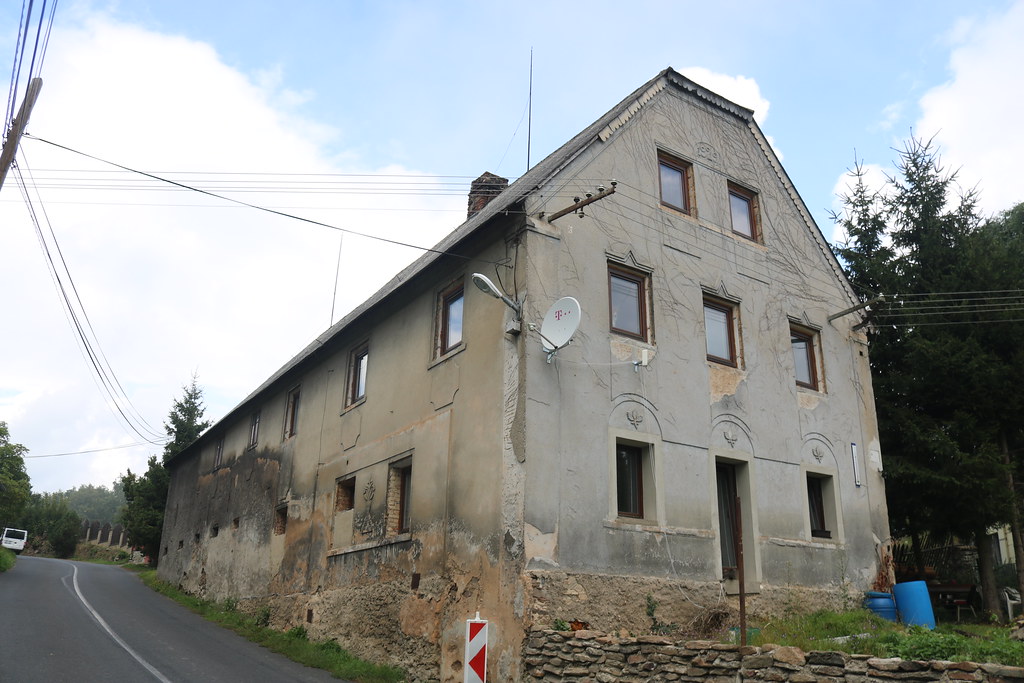
Visited:12. 9. 2021
History:Šerchov (German: Schergau) is a small village located about 6 kilometres north of Chomutov. The name of the village is derived from the Middle High German word scherge (court servant, messenger, herald). In historical sources the name of the village appears in the following forms: Ssericha (1479), w Sserych (1552), in the village of Sserchow (1561), Schercha (1563), Sserchow (1564, 1587), in the village of Sserchowie (1571), Scherchau or Schercher Zoll (1604), Czercha (1606), Tscherga (1608), Czercha (1622), Ssergaw (1654) or Schergau (1846). This village was probably founded sometime during the 14th century. The first written mention of Scherchow appeared in 1382-1393 in the books of the Order of German Knights of the Chomutov Commandery. However, according to the analysis of cadastral maps, it is possible that Radenov belongs to the oldest settlements of the so-called Chomutov district and was part of the property donated by Bedřich Načeratec to the Order in 1252. The village remained part of the Chomutov estate until 1605, when part of the property confiscated from Jiří Popel of Lobkowice was bought by Adam Hrzán of Harasov, who annexed it to Červený hrádek. In the sixteenth century, one of the branches of the trade route from Jirkov to Saxon Meissen passed through the village. There used to be a customs post here, which collected an average of ten kopecks per year in fees. The consequences of the Thirty Years' War probably did not affect Šerchov, because according to the Berni Rula of 1654 the village was in good condition. It was inhabited by five peasants and six cottagers, more than half of whom owned part of the forest and one of the cottagers worked as a coachman. Apart from farming, they also earned money by selling timber in Chomutov. The peasants owned fourteen covers, eighteen cows, 21 heifers, seven pigs and ten goats. The poorer cottagers had a total of seven covers, ten cows, sixteen heifers, three pigs and twelve goats. In the vicinity of the village small vein deposits of iron ore were mined and supplied to Vysoké Pec. In the nineteenth century shingles were made and in 1846 an inn is mentioned. After the abolition of the patrimonial administration, the village became part of the municipality of Blatno, where it belonged until 1880, when it became an independent municipality. During the second half of the 19th century, a chapel was built in the village square, which was unfortunately demolished during the second half of the 20th century. After the expulsion of the German population at the end of World War II and the resettlement of the inhabitants from the interior, the village became almost depopulated. While in 1930 a total of 84 inhabitants were listed here, in 1950 only 21 inhabitants were listed. This depopulation then caused the village to become part of the municipality of Blatno again in 1961, where it still belongs today. According to the 2011 census there were 37 inhabitants.
Source:https://cs.wikipedia.org/wiki/%C5%A0erchov
Impressions:A small village, located north of Chomutov, where there are several attractions.