Visited:13. 9. 2021
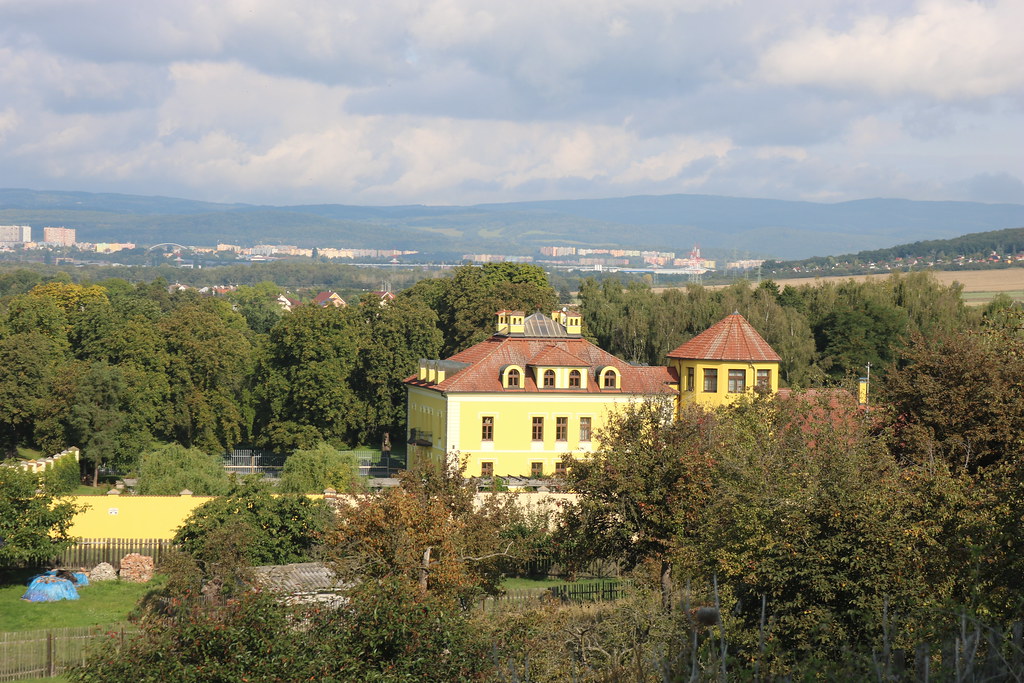
History:Přečaply (German: Pritschapl) is a village located about 1 kilometre southeast of Údlice. The name of the village was derived from the phrase village of Přečapl, but like the word Počaply, its meaning is uncertain. It is often associated with the word stork or with the verb čapnouti (to catch, to catch, to squat). In historical sources the name of the village appears in the following forms: Pryczalpl (1352), Prziczapel (1369), Przyczapl (1384), de Przeczapl (1355), in Preczabl (1363), in Przieczapl (1378), Prochzalp alias Przieczapli (1399), in Przieczapl (1413), Przieczapl (1423), Przecziaply (1542) and Prytssapl (1606). The area around the village was inhabited already in prehistoric times. In the younger period there was a settlement in the area of Kostelní vrch and in the adjacent area to the north of it. There may have been a two-part hillfort here at that time, but its existence can only be inferred from faint field indications, and archaeological research would be necessary to prove it. Antonín Profous mentions the first written reference to the village in 1352, but according to Zdena Binterová, the village is mentioned as early as the second half of the twelfth century in a document in which Queen Judith of Thuringia gave the court in Přečaple to the Teplice monastery. The village then belonged to the monastery until 1420. The monastery ceased to exist at the beginning of the Hussite wars, and with it, reports about Přečaple ceased until the sixteenth century. In the sixteenth century, Přečaply was part of the Neabylický manor, which was bought in 1578 by Bohuslav Felix Hasištejnský of Lobkovice, who annexed both villages to the Chomutov manor. Later on, Jiří Popel of Lobkovice acquired the estate and started the process of recatholization, inviting Jesuits to Chomutov, to whom the Přechapels were obliged to pay 41 kopeks and one grosz annually from 1591. After the fall of George Popel, his property was confiscated and divided into parts due to its size. Přečaply with 37 subjects was then bought together with Červený Hrádek by Adam Hrzán of Harasov in 1605. The village remained part of the Red Hrádek estate until the abolition of serfdom in 1850. After the abolition of the patrimonial administration in the middle of the 19th century, the village became an independent municipality. In spite of the recatholization started by George Popel of Lobkowitz, Protestants lived in the village even in the 17th century. During the Thirty Years' War, a military skirmish took place here in which the troops led by Peter Arnošt Mansfeld were defeated. The village itself suffered great damage. During the war, the village documents, including the coat of arms, were lost and many of the farmsteads were abandoned. Five deserted cottages are still mentioned in the Berni rula of 1654. According to it, there was a mill in the village and eight peasants lived there, who owned 22 cows, twelve cows, twenty heifers, 44 sheep, 23 pigs and eleven goats. One of them ran a sheepfold. In addition to the peasants, there were twelve cottagers in the village, who owned two covers, seventeen cows, eleven heifers, four sheep, five pigs and eight goats. The first mention of a local school dates back to 1662. From 1700 it had its own building, which was replaced by a new one in 1852. In 1925 it was raised by one floor to allow the opening of a fourth year. The school building was demolished in 1962. Before 1787, the village had a hospital for twelve patients. In 1836 a fire destroyed the rectory and twelve houses, but otherwise the village developed successfully in the nineteenth century. In 1846-1847 a new road to Údlice was built. The material needed for its construction was mined from the slopes of Kostelní vrch. In 1856, a sugar factory equipped with six steam engines was opened under the hill, where raw sugar was produced and delivered to the sugar factory in Údlice for processing. There was a sand pit and a small brickworks for the needs of the village. The construction of a railway line to Postoloprty was planned, but eventually it was not realised. The Marie Pomocná lignite mine was an important lignite mine near the village since 1920. Before that, there was a small mine Margareta with an annual production of 1500 tons of coal on its mine field since the mid-nineteenth century. Later it was renamed Marie Pomocná, but the intensity of mining was low and only two to three thousand tonnes of coal were extracted annually from a depth of up to forty metres. After 1918, a new mining pit was opened 1.5 km east of the village, connected by a cable car to the local sugar factory. During the First Republic, the main pit area between Přečaply and Údlice was mined for three kilometres. The total production of the mine was estimated at up to 600,000 tonnes of coal by 1940. The second larger enterprise near Přečaply was the Matěj Šebestián mine, whose mine field was connected to the Marie Pomocná mine in 1919 and which produced eighty thousand tonnes of coal by that time. The older and smaller mines Bernard, Kateřina, Lorenc, Jan, Karolina and others mostly ceased operations during the economic crisis after 1873. Most of the documents from the first half of the twentieth century have been lost. From the end of the Second World War there is a record of the shooting down of an American bomber plane by a German crew from Holešice on 17 April 1945. The plane exploded while still in the air and crashed in the fields about two kilometers northwest of Přečapel. The remains of the crew were buried in a common grave northeast of the village. After 1945, the German inhabitants were displaced and subsequently resettled from the interior, and the population of the village was approximately halved. Thus, while in 1930 there were 527 inhabitants, in 1950 there were only 262 inhabitants. This resulted in the village becoming part of the municipality of Údlice and losing its independence in 1961. In 1993 the village was gassed. According to the 2011 census there were 140 inhabitants.
Source:https://cs.wikipedia.org/wiki/P%C5%99e%C4%8Daply
Impressions:A large village, located southeast of Údlice, where there are several attractions.