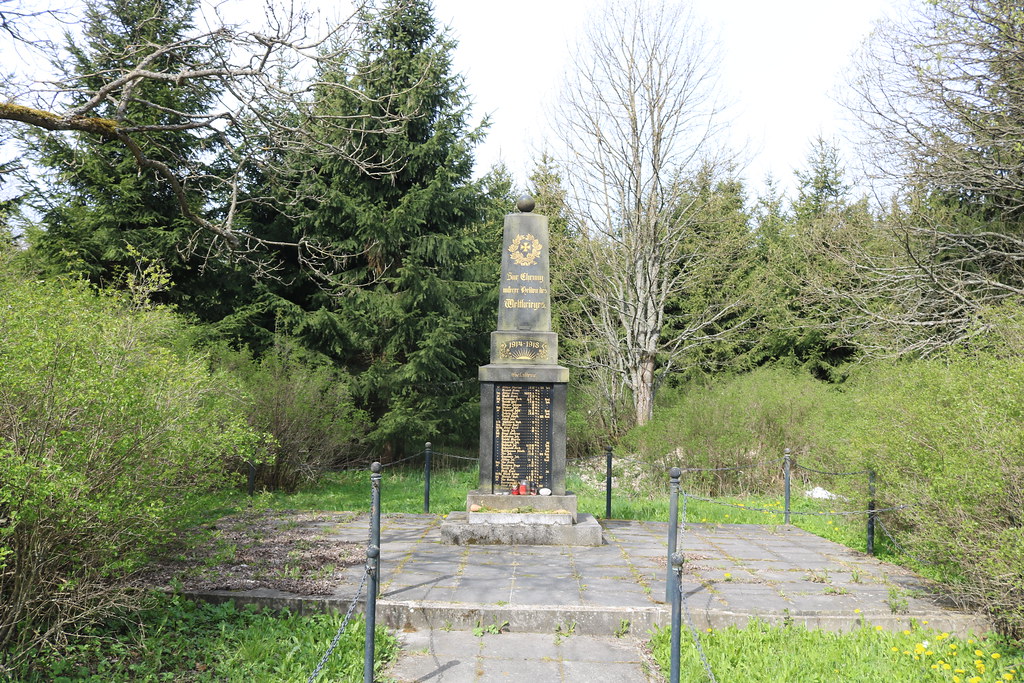
Visited:8. 5. 2020
History:Mezilesí (German: Orpus) is a village located about 5 kilometres southwest of Kryštofův Hamry. The original German name is probably a heavily mangled variant of Arpuse Wassermelone, in which case it would be the surname of a settler. In historical sources the name of the village appears in the forms Orpes, Orpis, Orpus (1787) and Orpus (1846). An alternative explanation of the origin of the name is its derivation from the Latin word urbis, i.e. town. The modern name Mezilesí u Přísečnice was chosen from the site's remote location in the woods and established by decree in 1949. The history of the settlement is closely linked to the local iron ore mines and ore processing hammers. These were already standing in the vicinity of Přísečnice in the middle of the fourteenth century and belonged to the Lords of Šumburk. However, the oldest mines are documented in writing only from the second half of the sixteenth century. The mines in Mezilesí mined magnetite deposits deposited on the skarn lens. The first mine documented in writing is Dorota (1577,[3] 1644) and in 1688 other mines are mentioned: Gabriela, Slečna, Sedm bratří and Marie pomocná. In 1789-1791 the Help of God mine was put into operation. In the middle of the eighteenth century, the mines in Mesile produced about 1500 tons of ore per year (almost half of the production of all mines in the Chomutov region). Most of the ore was processed in the ironworks in Perštejn, Kovářská, Gabrielina Huta and Kalku. A smaller part was shipped to Saxony. After the demise of the surrounding ironworks, which were unable to compete with the larger companies in Kladno and Ostrava, local mining gradually declined and eventually ceased altogether. The mines were dewatered by the Přísečník heirloom mine called the House of Austria, from which a branch called the Lederburg face led to Mezilesí. After the end of the Seven Years' War, the Habsburg Monarchy needed to strengthen the economic base of the country, so the mine was maintained at state expense. The largest of these mines was Dorota, which produced over 1,000 tonnes of magnetite per year between 1794 and 1846. The other mines operated intermittently and, although they reached greater depths, their productivity was considerably lower. The last mine north of Mezilesí was the Fischer mine, with several shafts that produced magnetite from depths of up to 55 metres. During the nineteenth century it provided 200-1100 tonnes of ore per year. It was only maintained after 1880 and was reopened at the beginning of the 20th century. At that time, several dozen miners worked there. In the second half of the twentieth century, the nearby Václav deposit was mined on an experimental basis and 15 000 tonnes of iron ore were extracted from the Fischer mine tailings. In addition to iron ore, precious metals (bismuth) were also mined at Mezilesí. After 1660, a limestone quarry operated here, from which the raw material was supplied to the brickworks in Kryštofův Hamry. Four years later, a lime kiln was established in Mezilesí. Around the same time, silver mining is also mentioned. The settlement was founded in the eighteenth century and the first written mention of it dates back to 1712. The number of houses grew from six in 1787 to twelve in 1846, when 87 inhabitants lived there. The settlement was small, but due to its remoteness its inhabitants established a volunteer fire brigade and a one-class school in the early twentieth century, which was a branch of the school in Dolina. It was often impossible for children to go to Dolina in winter. Although the surrounding area was not suitable for farming, the people were still involved in it. The crops they grew were especially important in times of scarcity, which included the great economic crisis of the 1930s. The village had only one shop and two inns, which were popular tourist destinations from spring to autumn. After the Second World War, the population of Mezilesí fell to about one-sixth of its pre-war number and continued to decline. By the early 1960s the village was almost devoid of inhabitants and had turned into a small holiday village. In 1930 there were still 96 inhabitants and after the German population was expelled in 1950 the number of inhabitants was only 15 and according to the 2011 census there were only 2 inhabitants. After the abolition of the patrimonial administration in the middle of the 19th century, the village became part of the municipality of Dolina in 1961, became part of the municipality of Přísečnice and finally became part of the municipality of Kryštofovy hamry in 1974, where it still falls today.
Source:https://cs.wikipedia.org/wiki/Meziles%C3%AD_(Kry%C5%A1tofovy_Hamry)
Impressions:Nowadays only a few houses, located southeast of Kryštofovy Hamry, where there are a few interesting things.