Visited:30. 9. 2021
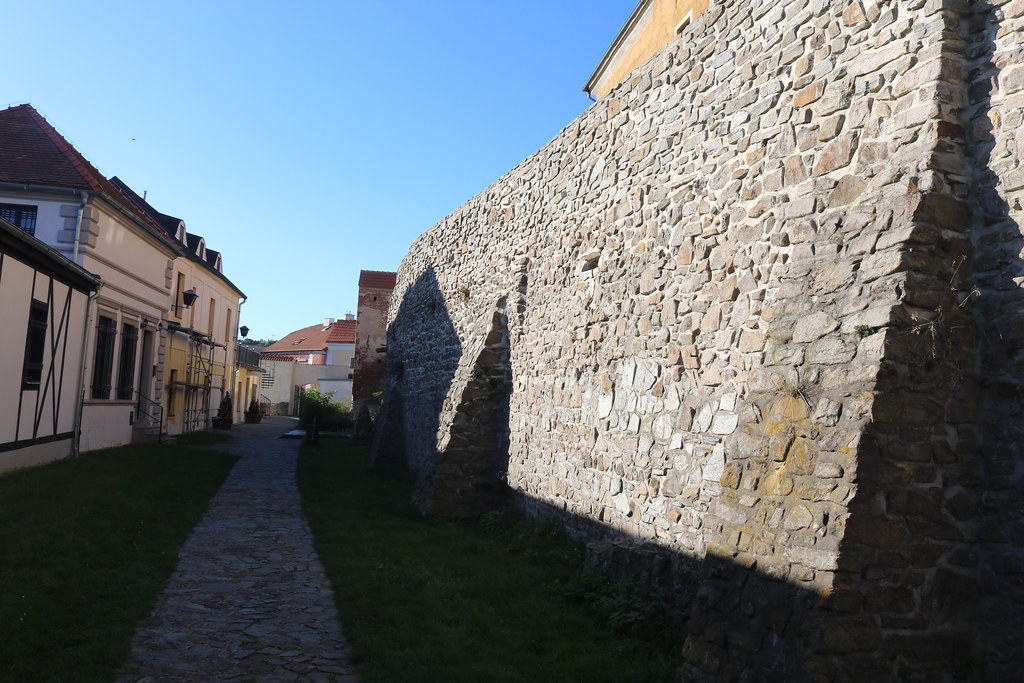
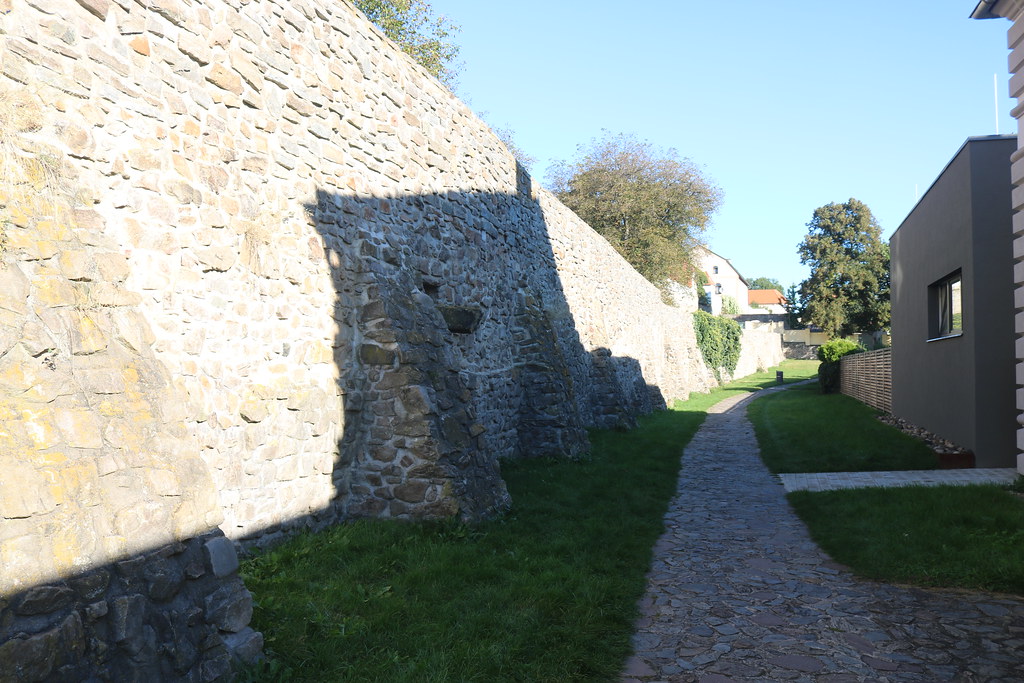
History:The town fortifications played an important role during the Hussite Wars, especially during the siege of the town on 8 September 1421 by the troops of the Second Crusade. The city walls were an important symbol of pride for the city. For the townspeople of Kadan, the walls were perhaps even sacred. This is evidenced, for example, by the festival that took place in the town every year around the feast of the Three Kings (6 January), during which the Dean of Kadan blessed the gates and walls with holy water and incense. The construction of the fortifications of the central part of the so-called Old Town in Kadan was strongly influenced by the terrain. The Old Town of Kadan stands on a strategic elevation, which is partly made up of rune rock. The town is protected from the south by the Ohře River. In the east, the Bystřice River (which was piped away in the second half of the 20th century). The fortification consists of an irregular rectangle measuring approximately 500 metres from south to north and 350 metres from east to west. The heart of the Old Town fortifications is the Kadan Castle. The town hall tower, conveniently located almost in the centre of the town, fulfilled an important function as the main watchtower. The Old Town was encircled by three belts of walls, with only two belts in the stretch along the Ohře River. However, these were built directly on the rock, which increased their strength. The fortification was breached by four main gates, i.e. Žatecka, Vodní, Svata and Prunéřovská gates, and the smaller Kata gate. The main gates were also protected by massive fortifications, for example, the fortification of the Žatec Gate has been preserved in the form of a large barbican. Between the city gates there were thirty defensive bastions and towers, among the most important preserved ones are the Minorite or the Spital bastion. The effectiveness of the defences was also significantly enhanced by the fact that the walls were provided with a so-called parcan, also called Zwinger. A double masonry moat was also created in the area in front of the wall bands. Since the 15th century, Kadan has also had its suburbs fortified. The city gates were closed around ten o'clock in the evening. It was not possible to enter the town at night. Violation of the ban was punished in an exemplary manner as an attack on the city's sovereignty. In 1570, when someone climbed over the walls at night and mocked a guard, he was put to the pillory by iron by the neck and banished from the city for ten years by the decision of the Kadan City Council. The only exception was the executioner's gate, which remained open at night, for example for the guards. The administration of the wall sections was handled by the so-called quartermasters, the administrators of the individual districts. The Old Town was divided into four administrative districts, the suburbs comprised a total of 9 smaller districts. Each district had its own military detachment composed of townspeople, which was ready to defend its section of the walls in case of a threat. According to a town decree of 1579, the townspeople maintained a guard of several dozen men. Three of them guarded the bridge over the Ohře River. Another three kept guard at the Žatec Gate. A two-man guard was on the tower of the Potter's Gate. One each was also guarding Katova and Luční Gate. The garrison of the large city gates of Prunerovská and Svata consisted of three men each. Prunéřovská and Svatá Gates, which followed them, had two guards each. One additional guard was in charge of the Water Gate and the other nine were at the disposal of the town clerk. At the beginning of the 19th century the fortifications lost their importance, and in 1820 the regulation on closing the gates was abolished. Gradually, some sections were sanitized, but most significantly after the visit of the highest Bohemian purgrave, Count Karel Chotek of Chotek and Vojnín, on 20 August 1831, who initiated the establishment of a fencing association in Kadani. He advocated the establishment of orchards and parks at the expense of the historical fortifications. In 1906, the Powder Tower was the last to be demolished as part of the work for the unemployed. In 2019, the city had the walls reconstructed according to a 2016 study by Petr Uhlík's architectural office. In a few months, two of the five sections of the walls were reconstructed at a cost of CZK 15.4 million. A fountain, benches, a wooden pergola, gravel paving and a completely new drainage system were built.
Source:https://cs.wikipedia.org/wiki/M%C4%9Bstsk%C3%A9_opevn%C4%9Bn%C3%AD_(Kada%C5%88)
Impressions:The beautiful and massive city walls, which have been preserved here in quite large sections.