Visited:12. 9. 2021
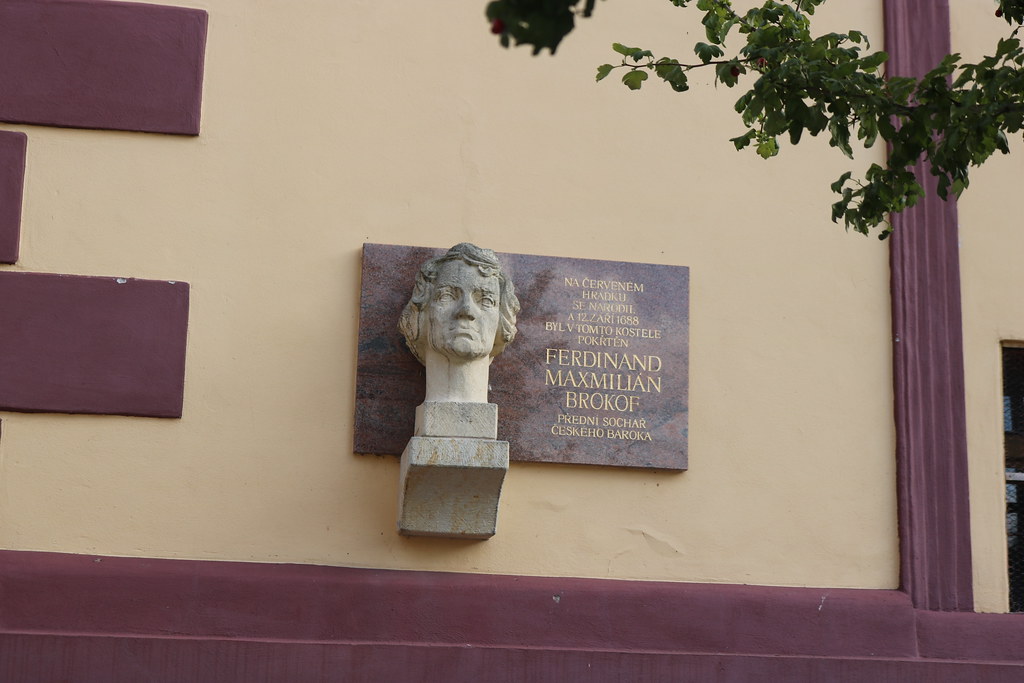
History:This monument to Ferdinand Maxmilián Brokoff was created by Jirkov sculptor Miroslav Doležal and was unveiled on 12 September 2012. And who was this man? Ferdinand Maxmilián Brokoff was born on 12 September 1688 in Červený Hrádek in western Bohemia as the second son of Jan Brokoff, who worked on the decoration of the castle there. He was baptised on 12 September 1688 in the church in Jirkov, but there is another document of baptism which was performed in the chateau chapel at Červený Hrádek on 9 September 1688. He was named Ferdinand Maximilian after the then owner of the castle, Count Ferdinand Maximilian Hrzán, who was his godfather. Like his older brother Michal Jan Josef, Ferdinand continued the family tradition and learned sculpture and carving in the workshop of his father, who was a citizen of the Old Town of Prague from 1693. There is no verifiable information about his further education. It is stated that in 1708-1713 he may have studied in the workshop of the then famous stone sculptor Ondřej Filip Quitainer. According to some art historians, Ferdinand's work and knowledge of marble work suggest that he may also have gained experience abroad, in Vienna at the Strudel Brothers' Academy of Court Artists and in Rome, where he may have been influenced by the work of Gian Lorenzo Bernini. In Prague, his main model was the early Baroque carver and sculptor Jan Jiří Bendl. Probably from 1709 Ferdinand was already working independently. During his travels Brokoff met the important Austrian court architect Jan Fischer of Erlach in Vienna around 1714, with whom he later collaborated on important works. Together with him, he won commissions from Vienna and Wroclaw in Silesia, but they also worked together for Prague and for Czech clients. In 1717, his father bought the house U salátů, where he also moved his workshop (the palace of the Porges of Portheim was later built on this site on what is now Národní třída). He also employed his sons Michal Jan Josef and Ferdinand Maximilian there. After his death in 1718, the elder Michael ran it, but he died three years later unmarried and childless. Ferdinand took over the family property and lived in the house with his mother. He created a number of sculptures in Prague and other places. The extent of his work testifies to his great diligence and also his organizational skills in running a sculpture workshop. He created most of his works himself, but in the last period of his life he had to use helpers due to his illness, e.g. for the Marian Plague Column on Hradčany Square in Prague (1726), the tomb of Bishop Trautson in Vienna (1727) or the façade of the church in Krzeszów (1729). In 1728 Ferdinand accepted citizenship in the New Town of Prague. He died childless at the age of 42 from souchotiny, a common disease of sculptors, caused by silicosis, i.e. dusting of the lungs with siliceous dust from carved stone. His father and brother died of the same diagnosis. In 1732, Ferdinand was buried in the churchyard of St. Martin's Church in the Wall in Prague's Old Town, where there is also a memorial plaque of the Brokoff family with a relief portrait of Ferdinand Brokoff. The bronze plaque was created by sculptor Josef Mařatka in 1909, based on the surviving portraits - a drawing by Jan Jakub Quirin Jahn, an etching by J. K. Burdet and an engraving by K. Salzer. Her mother died in 1735, her younger sister Elisabeth Anna Eleonora was married to the goldsmith Oberholtzer and died childless. The youngest of the siblings, Antonín Šebestián, studied philosophy and lived as a poet at the imperial court in Vienna, where he died after 1744. He was the last of the Brokoff family. Ferdinand Brokoff's extensive sculptural and carving work is often referred to as the pearl of Czech Baroque art of the first half of the 18th century. He worked most often with sandstone, but he was also skilled in marble and wood. The basis of Brokoff's sculptural expression is the realistic depiction of reality, which he mixed with Baroque illusionism. He drew on the ancient concept of sculpture, depicting figures of realistic proportions in counterpoint, expressing natural movement and mass, and by treating drapery he reinforced the basic volumetric layout. He conceived the sculptures with regard to the character of the space and architecture in which they were to be placed, in order to impress the viewer. He did not create expressive art, but his sculptures exude an intrinsic inner experience that comes from the core of the sculpture. His work is strongly dominated by religious themes. The statues of saints appear calm, serene and each bears certain individual features that correspond to real-life figures. Angels are depicted as strong young men. In one of the angels on the sculpture of St. Francis Xaversky on Charles Bridge, the likeness of Ferdinand Brokoff himself was seen. He was the most gifted member of the Brokoff family and very early on participated in the work of the family workshop, which was reflected in the increased quality of the sculptural work. Although most of the sculptures from Brokoff's workshop were usually signed by the owner, his father Jan, it is indisputable that many works not only for Charles Bridge were carried out by his sons. Later, Ferdinand marked his stone works with the words FECIT BROKOFF, BROKOF or monogram. His name first appeared on the sculptures of atlants in the facade of the Morzine Palace in 1714.
Source:https://cs.wikipedia.org/wiki/Ferdinand_Maxmili%C3%A1n_Brokoff
Source:https://chomutovsky.denik.cz/zpravy_region/jirkovskou-vez-ozdobi-busta-slavneho-sochare-z-hradku-20120527.html
Impressions:A simple monument commemorating a local notable.